
VioletaStoimenova
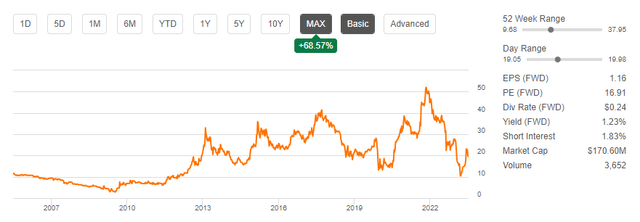
First Internet Bancorp (NASDAQ:INBK) is a bank that capitalizes only $170 million and was founded at the peak of the Internet bubble in 1999.
Seeking Alpha
Its history has been characterized by a series of ups and downs, with often disappointing results in the harshest phases of the economic cycle. In fact, the price per share does not exhibit a long-term upward trend.
This lack of resilience also manifests itself in the Price/Book Value, which is often lower than the benchmark industry average: investors require a high margin of safety before investing in it. Currently that ratio is only 0.48x for First Internet, a sign of strong undervaluation given that the industry average is 1x.
Based on the latest quarterly report I will state my view on this, and more specifically the risks of buying it at the current price.
Loans and net interest margin
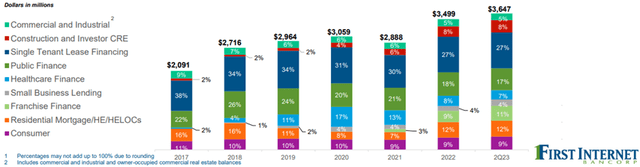
The current economic environment makes access to credit less favorable, yet First Internet continues to increase its loan portfolio.
First Internet Q2 2023
Not only that, in addition to constantly growing that portfolio is also quite diversified.
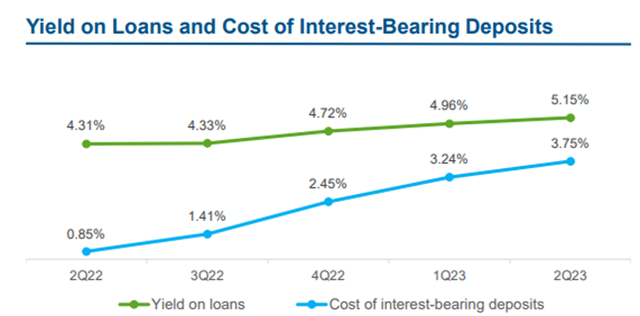
At first glance it would seem that First Internet is in an ideal situation, but actually there is a major underlying problem: loan yields are not increasing fast enough.
The rapid rise in the Fed Funds Rate has made bank deposits more expensive, and as a result banks–in order to avoid squeezing margins too much–have been forced to issue loans at a significantly higher rate. If the cost of deposits does not rise faster than the yield on loans there is no problem, but when this scenario is reversed here is where profitability suffers a major setback.
First Internet Q2 2023
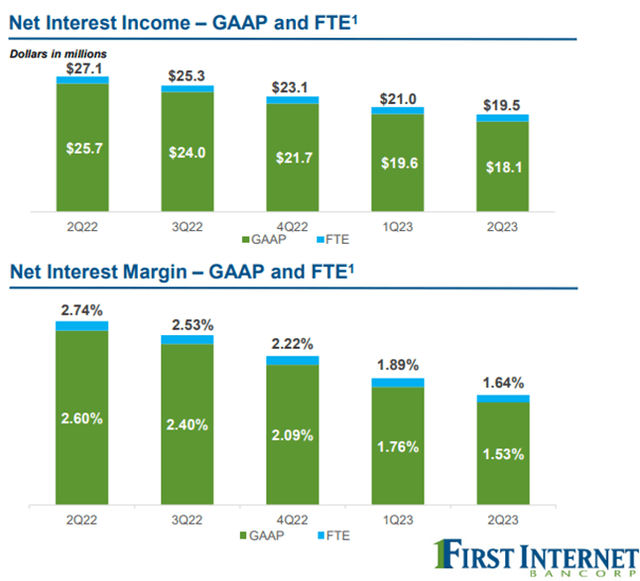
It is since Q2 2022 that this negative trend has begun, and the spread between loan yields and the cost of deposits is getting thinner and thinner. Both net interest income and net interest margin are suffering.
First Internet Q2 2023
In light of this data, it is evident why this bank has collapsed so much; moreover, no improvement is expected in the short to medium term. In the next quarter the NIM is expected to be between 1.50-1.55%, in Q4 2024 it could reach 1.90-1.95%, still a result below FY2022.
We expect the overall loan portfolio yield to continue going up in the range of 15 to 20 basis points. But given the rate hike yesterday from the Fed and perhaps another one here on the horizon, we do expect deposit costs to continue to go up as well. If you look back in prior quarters and the pace of deposit cost is, you know, obviously it’s outpaced the increase in loan and securities and cash income. And we expect that that gap to narrow significantly in the third quarter. We still expect a little bit of compression on net interest margin and net interest income.
CFO Ken Lovik, conference call Q2 2023.
In short, compression of the NIM is likely in the coming quarters as well, and as long as rates rise this trend is unlikely to reverse. It is necessary for the Fed to reach the terminal rate to see the NIM breathe again.
Deposits
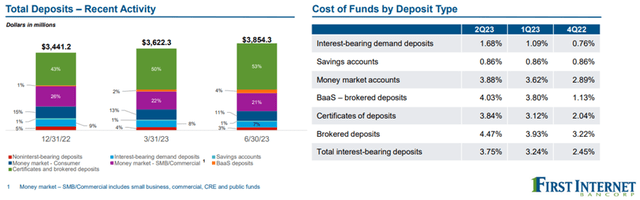
Although growing, deposits are in my opinion the biggest weakness for this bank because their cost has been rising too fast. A bank with a competitive advantage can keep the cost of deposits low, but this has not been the case.
First Internet Q2 2023
The cost of total interest-bearing deposits was already high in Q4 2022, but in Q2 2023 it reached as high as 3.75%. Even at around 2% this figure would have been too high; at 3.75% it is out of the norm. But there is more.
Deloitte Center for Financial Services
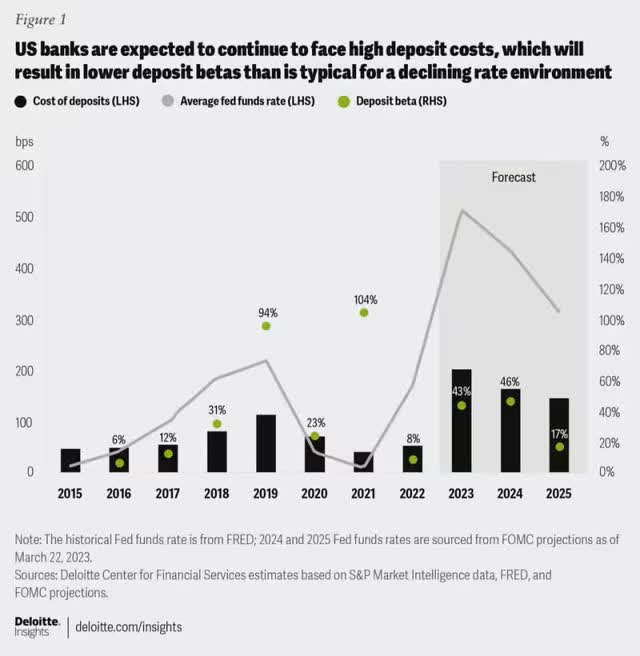
According to a study by Deloitte, the cost of deposits could remain high in the coming years regardless of the Fed Funds Rate.
After years with interest rates close to 0%, customers are now pushing to continue to receive substantial interest on their deposits and are unlikely to give them up. Competition is high, and reducing that interest too much in the future could mean losing an important portion of deposits.
Even if the Fed Funds Rate were to fall, the cost of deposits is expected to remain high: 1.70 percent in 2024 and 1.50 percent in 2025. At the same time, there is no guarantee that banks will be able to originate loans at current market rates. In other words, this scenario would further weaken banks, especially those like First Internet that have been unable to prevent the cost of deposits from skyrocketing.
First Internet Q2 2023
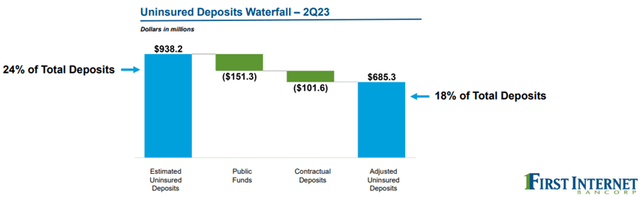
On the positive side, only a small percentage of deposits are uninsured, so at least a bank run is averted if the financial situation tightens. As mentioned above, the problem will be figuring out how to reduce the cost of deposits without losing too many customers.
Shareholder remuneration
First Internet remunerates shareholders through both dividends and buybacks.
Seeking Alpha
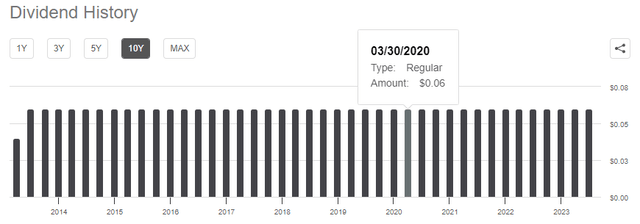
In the first case it is a constant remuneration, as the dividend per share issued has been the same since 2014. It is certainly sustainable, but the fact that it does not grow over time makes this bank less attractive to investors hunting for dividend companies.
Personally, if this is the premise, I wonder why issue a dividend at this point. If I were a shareholder, I would prefer that this money be reinvested in the company. In other words, the dividend is unlikely to be the motivation for some investors to buy this bank. Different argument for the buyback.
Since 2018, shares outstanding have decreased by 16 percent, and over the past few months management has taken advantage of the low price per share to repurchase its own shares.
During Q2 2023, 203,000 common shares were repurchased at an average price of $13.52 per share. In total, $38.90 million shares have been repurchased since November 2021. As a result of the share repurchase activity, tangible book value per share increased to $39.85 at the end of the quarter, an increase of nearly 4 percent from the previous year.
According to the CFO’s words, if the price had remained around $13 per share the buyback would have continued, but around $20-25 per share is likely to stop here. Buying back own shares results in the deterioration of equity and this worsens capital requirements. It is critical for banks not to overweight it, partly because there are already unrealized losses from AFS securities weighing negatively on equity.
Conclusion
First Internet is a bank that is experiencing profitability challenges dictated by an almost out-of-control cost of deposits. Loan yields are increasing and are expected to rise 15-20 bps in the coming quarters, but this is not enough to bring up the net interest margin to historical levels.
Capital IQ
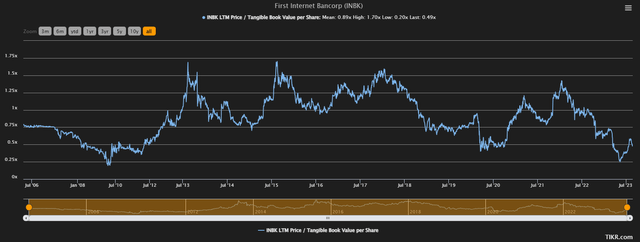
In any case, these difficulties have probably already been discounted, in fact the Price/Tangible Book Value is only 0.49x while the historical average is around 0.89x. During the period of maximum panic this ratio even reached 0.25x, a value not seen since the great financial crisis of 2008. On those levels First Internet was definitely a bargain, but it is easy to talk in retrospect.
On paper this bank still looks undervalued, but after the recent rally the potential return on investment has been greatly reduced. In my opinion, at the current price I believe this bank is undervalued but not a bargain. Since the degree of risk is high given the stressed NIM, I would only invest in it if the price is so discounted that there is a huge margin of safety. This opportunity has already been gone for several months.
Apparently, management also seems to think the same way, in fact as previously discussed, around $13 per share the buyback was too great an opportunity not to take advantage of. Today, however, around $20 per share the risk of not getting a sufficient margin of safety is high.
Credit: Source link