• bitcoinBitcoin(BTC)$79,908.000.36%
  • ethereumEthereum(ETH)$2,501.551.92%
  • tetherTether(USDT)$1.00-0.01%
  • binancecoinBNB(BNB)$758.131.23%
  • rippleXRP(XRP)$1.421.15%
  • usd-coinUSDC(USDC)$1.000.00%
  • solanaSolana(SOL)$106.434.00%
  • tronTRON(TRX)$0.3349460.52%
  • Figure HelocFigure Heloc(FIGR_HELOC)$1.061.58%
  • zcashZcash(ZEC)$1,184.6016.72%
  • HyperliquidHyperliquid(HYPE)$88.514.27%
  • dogecoinDogecoin(DOGE)$0.0900964.53%
  • RainRain(RAIN)$0.0170193.69%
  • moneroMonero(XMR)$538.240.35%
  • USDSUSDS(USDS)$1.00-0.01%
  • chainlinkChainlink(LINK)$12.274.64%
  • whitebitWhiteBIT Coin(WBT)$73.690.73%
  • leo-tokenLEO Token(LEO)$9.340.88%
  • cardanoCardano(ADA)$0.2207423.42%
  • stellarStellar(XLM)$0.1870311.95%
  • bitcoin-cashBitcoin Cash(BCH)$260.623.85%
  • daiDai(DAI)$1.000.02%
  • uniswapUniswap(UNI)$7.0713.01%
  • CantonCanton(CC)$0.1102791.74%
  • Ethena USDeEthena USDe(USDE)$1.00-0.01%
  • USD1USD1(USD1)$1.000.00%
  • litecoinLitecoin(LTC)$54.613.08%
  • the-open-networkGram (prev. Toncoin)(GRAM)$1.420.00%
  • hedera-hashgraphHedera(HBAR)$0.0815411.38%
  • avalanche-2Avalanche(AVAX)$7.692.55%
  • suiSui(SUI)$0.802.47%
  • Global DollarGlobal Dollar(USDG)$1.000.00%
  • shiba-inuShiba Inu(SHIB)$0.0000051.14%
  • nearNEAR Protocol(NEAR)$2.394.95%
  • paypal-usdPayPal USD(PYUSD)$1.00-0.01%
  • BlackRock USD Institutional Digital Liquidity FundBlackRock USD Institutional Digital Liquidity Fund(BUIDL)$1.000.00%
  • crypto-com-chainCronos(CRO)$0.0572892.20%
  • tether-goldTether Gold(XAUT)$4,423.39-0.06%
  • Circle USYCCircle USYC(USYC)$1.140.00%
  • MemeCoreMemeCore(M)$1.131.32%
  • Ripple USDRipple USD(RLUSD)$1.000.01%
  • okbOKB(OKB)$113.961.95%
  • BittensorBittensor(TAO)$241.760.83%
  • Ondo US Dollar YieldOndo US Dollar Yield(USDY)$1.140.19%
  • AsterAster(ASTER)$0.79-0.74%
  • aaveAave(AAVE)$135.564.63%
  • mantleMantle(MNT)$0.605.41%
  • pax-goldPAX Gold(PAXG)$4,429.98-0.08%
  • OndoOndo(ONDO)$0.3797402.78%
  • World Liberty FinancialWorld Liberty Financial(WLFI)$0.0569280.80%
TradePoint.io
  • Main
  • AI & Technology
  • Stock Charts
  • Market & News
  • Business
  • Finance Tips
  • Trade Tube
  • Blog
  • Shop
No Result
View All Result
TradePoint.io
No Result
View All Result

Google DeepMind Researchers Introduce SynJax: A Deep Learning Library For JAX Structured Probability Distribution

August 15, 2023
in AI & Technology
Reading Time: 5 mins read
A A
Google DeepMind Researchers Introduce SynJax: A Deep Learning Library For JAX Structured Probability Distribution
ShareShareShareShareShare

Data may be viewed as having a structure in various areas that explains how its components fit together to form a greater whole. Depending on the activity, this structure is typically latent and changes. Consider Figure 1 for illustrations of distinct structures in natural language. Together, the words make up a sequence. There is a part-of-speech tag applied to each word in a sequence. These tags are interconnected, generating the red-hued linear chain. By segmenting the sentence, which is depicted with bubbles, the words in the sentence may be put together into tiny, disjointed, contiguous clusters. A more thorough examination of language would reveal that groups may be made recursively, creating a syntactic tree structure. Structures can connect two languages as well. 

An alignment, for instance, in the same picture can link a Japanese translation to an English source. These grammatical constructs are universal. In biology, similar structures can be found. Tree-based models of RNA capture the hierarchical aspect of the protein folding process, whereas monotone alignment is used to match the nucleotides in RNA sequences. Genomic data is also split into contiguous groups. Most current deep-learning models make no explicit attempt to represent the intermediate structure and instead seek to predict output variables straight from the input. These models could benefit from explicit modeling of structure in several ways. Using the appropriate inductive biases could facilitate improved generalization. This would enhance downstream performance in addition to sample efficiency. 

Figure 1: Examples of natural language structures.

Explicit structure modeling can incorporate a problem-specific set of restrictions or methods. The judgments made by the model are also more easily understandable because of the discrete structure. Finally, there are occasions when the structure is the result of learning itself. For instance, they may be aware that the data is explained by a hidden structure of a certain shape, but they need to know more about it. For modeling sequences, auto-regressive models are the predominant technique. In some situations, non-sequential structures can be linearized and proxied by a sequential structure. These models are strong because they don’t rely on independent assumptions and can be trained using much data. While identifying the ideal structure or marginalizing over hidden variables are common inference issues, sampling from auto-regressive models is often not tractable. 

Using auto-regressive models in large-scale models is challenging because they demand biassed or high-variance approximations, which are frequently computationally costly. Models over factor graphs that factorize the same way as the target structure are an alternative to auto-regressive models. These models can precisely and efficiently calculate all interesting inference issues by employing specialized methods. Although each structure requires a unique method, each inference task does not require a specialized algorithm (argmax, sampling, marginals, entropy, etc.). To extract several numbers from just one function for each structure type, SynJax employs automated differentiation, as they shall demonstrate later. 
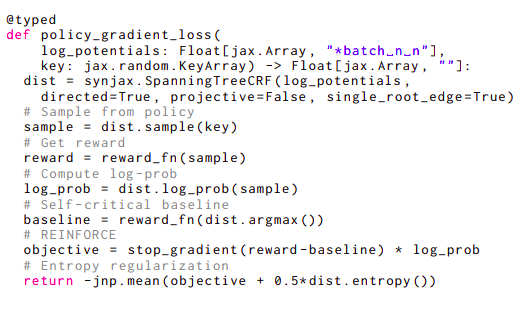
Figure 2: A spanning tree implementation example of a policy gradient with a self-critical baseline and entropy regularisation.

The lack of practical libraries that would offer accelerator-friendly implementations of structure components has slowed research into structured distributions for deep understanding, especially since these components depend on algorithms that frequently do not map directly onto available deep learning primitives, unlike Transformer models. Researchers from Google Deepmind offer simple-to-use structural primitives that combine within the JAX machine learning framework, helping SynJax solve the challenge. Consider the example in Figure 2 to demonstrate how simple SynJax is to use. This code implements a policy gradient loss that necessitates computing several parameters, including sampling, argmax, entropy, and log probability, each of which requires a separate approach. 

The structure is a nonprojective directed spanning tree with a single root edge restriction in this code line. As a result, SynJax will employ dist.sample() Wilson’s sampling approach for single-root trees, dist.entropy (), and Tarjan’s maximum spanning tree algorithm for single-root edge trees. Single-root edge trees can use the Matrix-Tree Theorem. Only one flag needs to be changed for SynJax to use entirely different algorithms that are suitable for that structure—Kuhlmann’s algorithm for argmax and various iterations of Eisner’s algorithm for other quantities—if they only want to slightly alter the type of trees by mandating that the trees adhere to the projectivity constraint as users. Because SynJax takes care of everything related to such algorithms, the user may concentrate on the modeling aspect of their issue without implementing them or even understanding how they work.


Check out the Paper and Github. All Credit For This Research Goes To the Researchers on This Project. Also, don’t forget to join our 28k+ ML SubReddit, 40k+ Facebook Community, Discord Channel, and Email Newsletter, where we share the latest AI research news, cool AI projects, and more.


YOU MAY ALSO LIKE

UC Berkeley Researchers Release CUA-Lite, an Open Platform Unifying Sandboxes, Data, Evaluation and RL for Computer-Use Agents

Perplexity Details Its GPU Embedding Stack: How Ivy, Tulip and ROSE Serve pplx-embed

Aneesh Tickoo is a consulting intern at MarktechPost. He is currently pursuing his undergraduate degree in Data Science and Artificial Intelligence from the Indian Institute of Technology(IIT), Bhilai. He spends most of his time working on projects aimed at harnessing the power of machine learning. His research interest is image processing and is passionate about building solutions around it. He loves to connect with people and collaborate on interesting projects.


🔥 Use SQL to predict the future (Sponsored)

Credit: Source link

ShareTweetSendSharePin

Related Posts

UC Berkeley Researchers Release CUA-Lite, an Open Platform Unifying Sandboxes, Data, Evaluation and RL for Computer-Use Agents
AI & Technology

UC Berkeley Researchers Release CUA-Lite, an Open Platform Unifying Sandboxes, Data, Evaluation and RL for Computer-Use Agents

September 6, 2026
Perplexity Details Its GPU Embedding Stack: How Ivy, Tulip and ROSE Serve pplx-embed
AI & Technology

Perplexity Details Its GPU Embedding Stack: How Ivy, Tulip and ROSE Serve pplx-embed

September 6, 2026
Is It Safe To Leave Your Phone’s Bluetooth Running All The Time?
AI & Technology

Is It Safe To Leave Your Phone’s Bluetooth Running All The Time?

September 5, 2026
Apple iTunes Still Exists, But Not The Way It Used To
AI & Technology

Apple iTunes Still Exists, But Not The Way It Used To

September 5, 2026
Next Post
Citigroup Surges on Better-than-Expected Earnings Surprise

Citigroup Surges on Better-than-Expected Earnings Surprise

Leave a Reply Cancel reply

Your email address will not be published. Required fields are marked *

Search

No Result
View All Result
Roland Releases Melody Flip, an AI Melody-Generation Plug-In for DAWs – Unite.AI

Roland Releases Melody Flip, an AI Melody-Generation Plug-In for DAWs – Unite.AI

September 4, 2026
Trump honors ‘beloved friend’ and ‘respected statesman’ Sen. Lindsey Graham at funeral

Trump honors ‘beloved friend’ and ‘respected statesman’ Sen. Lindsey Graham at funeral

September 3, 2026
HMAX:CA: Core Holding Pumping Out 11%+ With Low Risk (TSX:HMAX:CA)

HMAX:CA: Core Holding Pumping Out 11%+ With Low Risk (TSX:HMAX:CA)

August 30, 2026

About

Learn more

Our Services

Legal

Privacy Policy

Terms of Use

Bloggers

Learn more

Article Links

Contact

Advertise

Ask us anything

©2020- TradePoint.io - All rights reserved!

Tradepoint.io, being just a publishing and technology platform, is not a registered broker-dealer or investment adviser. So we do not provide investment advice. Rather, brokerage services are provided to clients of Tradepoint.io by independent SEC-registered broker-dealers and members of FINRA/SIPC. Every form of investing carries some risk and past performance is not a guarantee of future results. “Tradepoint.io“, “Instant Investing” and “My Trading Tools” are registered trademarks of Apperbuild, LLC.

This website is operated by Apperbuild, LLC. We have no link to any brokerage firm and we do not provide investment advice. Every information and resource we provide is solely for the education of our readers. © 2020 Apperbuild, LLC. All rights reserved.

No Result
View All Result
  • Main
  • AI & Technology
  • Stock Charts
  • Market & News
  • Business
  • Finance Tips
  • Trade Tube
  • Blog
  • Shop

© 2023 - TradePoint.io - All Rights Reserved!