

















wildpixel
Shares of argenx (NASDAQ:ARGX) surged to new all-time highs when the company reported positive phase 3 results of efgartigimod (brand names Vyvgart and Vyvgart Hytrulo) in CIDP patients in mid-July. The fears of some investors were not realized (primarily driven by the previous phase 2 failure of competing therapy – UCB’s rozanolixizumab in this patient population) and the results look as strong as one might have expected, if not better. The company is engaging regulators as it prepares the supplementary BLA filing, but the results are clear and positive with no safety concerns and I believe it is only a matter of time before Vyvgart reaches CIDP patients.
The success in CIDP was by far the most important milestone for argenx so far in 2023.
The second important milestone was Vyvgart’s net sales exceeding the annualized net sales run rate of $1 billion in the second quarter with the majority of sales still coming from the United States.
The third important milestone was the FDA approval of Vyvgart Hytrulo, the subcutaneous version of Vyvgart utilizing Halozyme’s (HALO) Enhanze technology for the treatment of generalized myasthenia gravis (‘gMG’) patients. The convenience of once-weekly subcutaneous administration should expand the market for Vyvgart and lead to improved uptake going forward.
There is still a lot more to come from Vyvgart in the gMG market as I would still characterize this as the early stages of the launch. I previously expected peak global net sales in this indication to be in the $1.5 billion to $2 billion range and would now increase the estimate to $2+ billion. The annualized net sales run rate of more than $1 billion was basically reached in the United States alone and the ex-US markets are just getting started – Japan and EMA contributed only $25 million in combined net sales in Q2. Growth in ex-U.S. markets should pick up in a more meaningful way in 2024 due to the continued progress in Japan and Germany and the expected launches in China, Canada, France, the UK, and Italy, and should be further enhanced by the availability of Vyvgart Hytrulo.
CIDP represents a similar opportunity to gMG and the results are similarly impressive as those in the gMG population. I wrote about this trial last year and expected a positive outcome due to the clinical evidence showing a correlation between IgG-lowering effects (efgartigimod’s mechanism of action) of several other therapies and the response rate of CIDP patients, the smart trial design featuring the open-label phase that was used for preliminary de-risking along with the more stringent patient identification as CIDP can often be misdiagnosed. Additionally, the go/no-go decision from February 2021 also served as a confidence booster.
Vyvgart’s response rate in the open-label stage of the trial where all patients received Vyvgart was 67%, and it was 78% in patients who received four or more infusions.
argenx investor presentation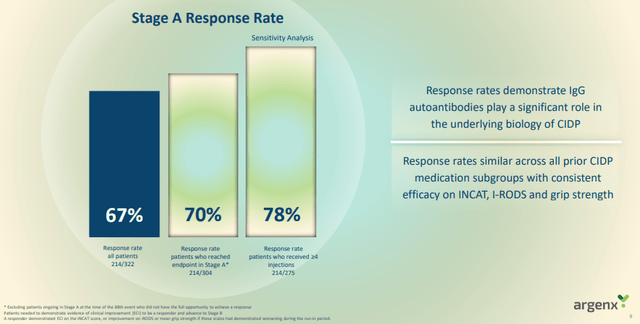
Patients were randomized to Vyvgart or placebo in stage B where the company waited for relapse events to accumulate to determine the effectiveness of the drug versus placebo. Vyvgart achieved a 61% reduction in the relative risk of relapse versus placebo, or a hazard ratio of 0.39 and a p-value of 0.000039.
argenx investor presentation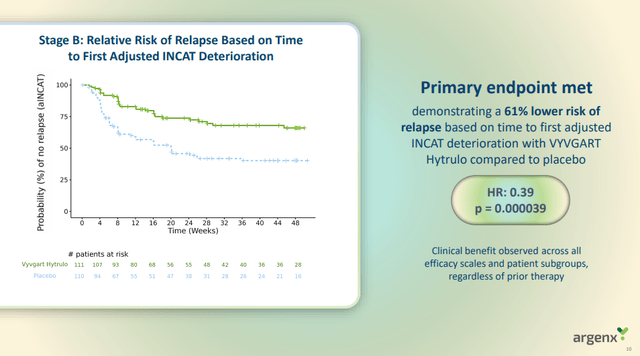
The effect was consistent across several secondary endpoints.
argenx investor presentation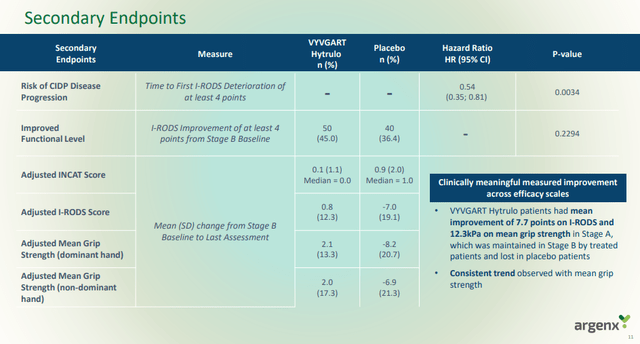
Importantly, there were no tradeoffs on the safety side. Most adverse events were considered mild or moderate, no increased infection rates with increased exposure were observed and no new safety signals were identified with up to 60 weeks of weekly treatment.
argenx investor presentation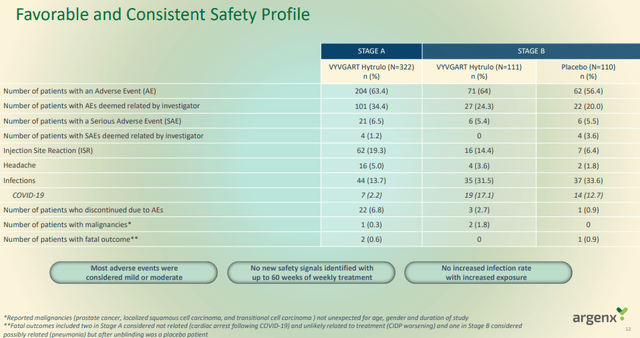
Overall, the data look supportive as CIDP being another blockbuster indication for Vyvgart.
Empasiprubart (ARGX-117) achieves preliminary proof of concept
This was not a major update for a company of argenx’s size, but argenx recently said that it has observed early efficacy signals of empasiprubart in multifocal motor neuropathy (‘MMN’) patients that show preliminary proof of concept in this indication. The independent data monitoring committee recommended study continuation based on the favorable safety profile observed in the first dose cohort.
This update went largely unnoticed, but rightly so because we only have the company’s word for it and no data. We will have to wait to see the data in 2024.
Additional upcoming clinical milestones
There are two important data readouts of Vyvgart in the fourth quarter:
- Phase 3 topline data from the ADDRESS trial in pemphigus vulgaris patients.
- Phase 3 topline data from the ADVANCE-SC trial of subcutaneous Vyvgart in primary immune thrombocytopenia (‘ITP’) patients.
It is reasonable to expect positive outcomes from both studies considering the positive data from the first phase 3 trial in ITP patients and the strong phase 2 results in pemphigus patients. However, I believe the risk is higher on the ITP side because previous results were not exactly impressive, and even if this trial is successful, I believe ITP represents the least attractive opportunity when compared to gMG, CIPD, and pemphigus.
The issue with the pemphigus trial is we do not have placebo-controlled data from the phase 2 trial – Vyvgart was only tested in the open-label trial, but the results look impressive with high rates of clinical remission.
I remain bullish on the company’s long-term growth prospects, but with the stock priced for continued clinical and commercial success of Vyvgart, the risk-reward does not look as strong as it was prior to the CIDP readout where the concerns about the outcome kept the stock in a trading range and we are now looking at a company near record highs and a $30 billion market cap.
Conclusion
Argenx reached three important milestones on three different fronts this year – clinical with success in the phase 3 trial in CIDP patients, commercial with Vyvgart reaching an annualized net sales run rate in excess of $1 billion in the second quarter, and regulatory with the approval of Vyvgart Hytrulo.
I continue to see argenx as very well positioned for additional long-term value creation despite the high market cap, but believe the near-term risk-reward is more balanced with the two upcoming readouts in ITP and pemphigus. But going back to the long-term outlook – the reasons to be bullish in the long run are the plentiful additional opportunities for Vyvgart with many additional clinical readouts in 2024 and beyond, the potential of empasiprubart in MMN and other indications, the company’s internal discovery engine, and also business development possibilities.
argenx investor presentation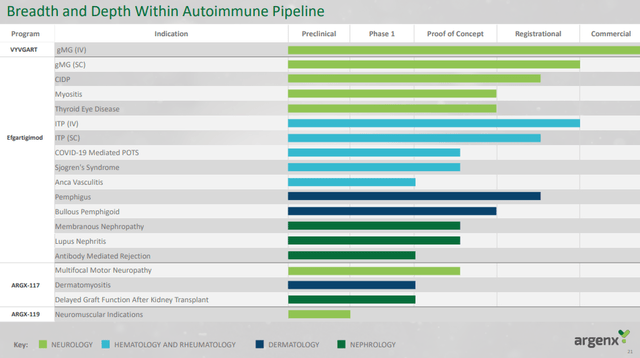
Speaking of business development, the company raised $1.3 billion in gross proceeds in a follow-on offering in July and this was, arguably, money the company did not need given the rapid revenue growth of Vyvgart, the strong balance sheet ($2 billion at the end of Q2) and the declining cash burn. With more than $3 billion in cash, externally driven pipeline expansion is another possibility for value creation going forward.
Credit: Source link