

Nikada/E+ via Getty Images
Dear readers/followers,
Iron Mountain Incorporated (NYSE:IRM) has been one of the best performing REITs over the past year and a half, returning a total of 27%, while the broader REIT market (VNQ) fell by 21%.
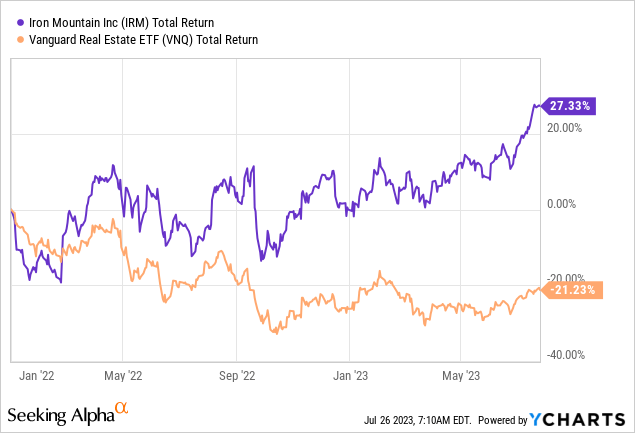
I find this outperformance quite strange, especially when we consider that IRM is focused on a sector which is at risk of a secular decline.
The REIT is quite unique in that it’s focused on data storage. The company owns paper storage facilities and has recently expanded into the data center business. With everything moving online, it’s easy to see how paper storage isn’t going to be a growth sector. That’s not to say that paper storage will disappear overnight, but it’s certainly not a sector which deserves a growth premium.
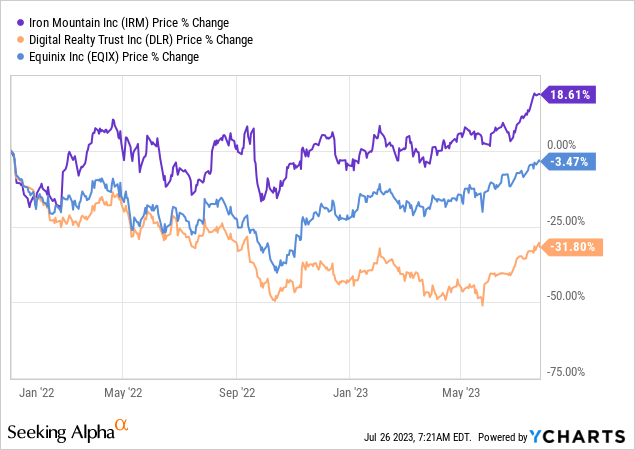
Data centers, on the other hand, sound exciting. But the thing is that pure data center REITs haven’t performed well either. Take Digital Realty Trust (DLR) or Equinix (EQIX), for example. Both of these have significantly underperformed IRM. The question then is what exactly is the market seeing in this company and is it justified.
One of the reasons, while the stock has rallied, were very good Q1 2023 results. Revenue has increased by double-digits YoY in constant FX terms and AFFO per share has reached $0.97, up 7% YoY.
AFFO has increased significantly above guidance, but as stated on the earnings call this was a consequence of delaying some maintenance CAPEX until the second quarter. As a result, AFFO is expected at $0.92 in Q2.
IRM Presentation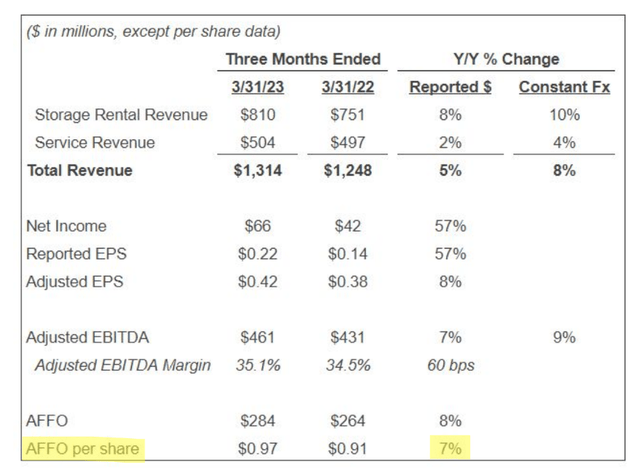
Notably, total growth has been decelerating, largely as a consequence of very low growth in service revenue. The reason for this, as cited on the earnings call, has been pricing, due to record-low prices across the semiconductor industry.
IRM Presentation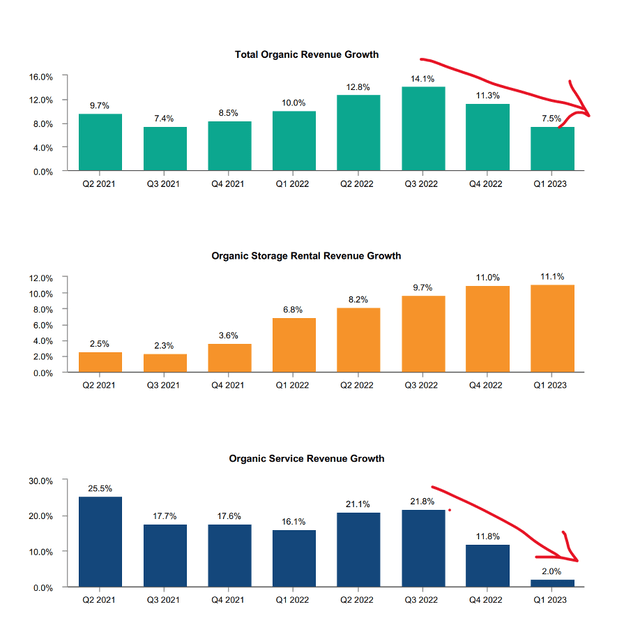
Beyond next quarter, the consensus is for a full 2023 AFFO of $3.96 (+4% YoY). To get there, AFFO per share would need to surpass $1 in both Q3 and Q4, which feels relatively doable if rental revenue growth continues to be strong.
In either case, the company has BB- rated balance sheet with net debt to EBITDA of 5.5x. Maturities are reasonably spread out over time. Note that IRM is trying to refinance $1 Billion of the revolving credit facility in the chart below by senior notes due in 2029 priced at 7%. This will improve the repayment profile, but will increase the average interest rate above the already high 5.3%.
IRM Presentation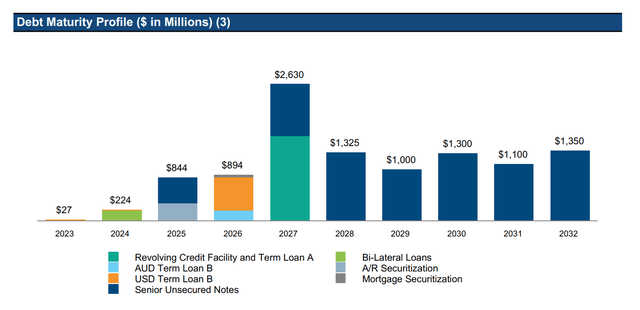
Dividends have barely grown over the past five years and currently stand at $0.62 per share, representing a yield of 4%. Over the past 12 months, the payout ratio has averaged 64%, which is in line with management’s target in the low to mid-60s.
The company has been doing well. But the balance sheet isn’t the strongest and I expect their growth to slow over time as paper storage starts to experience a secular decline. At the end of the day, it all comes down to valuation.
In short, IRM isn’t discounted. It currently trades at 16x AFFO which is well above its historical average of 12x. Frankly, the historical average is likely too low, because the company has only added data centers recently, and those generally trade at higher multiples than paper storage.
But even forecasting the company at 15x FFO and assuming aggressive AFFO growth of 6-8% in 2024 and 2025, the price target stands at barely above todays price at $68 per share. A mere 10% upside on top of a low 4% dividend simply isn’t good enough and likely isn’t worth the risk that comes with a sub-par balance sheet and questionable future growth prospects of the sector.
Therefore, I rate IRM stock as a HOLD here at $62 per share.
Fast Graphs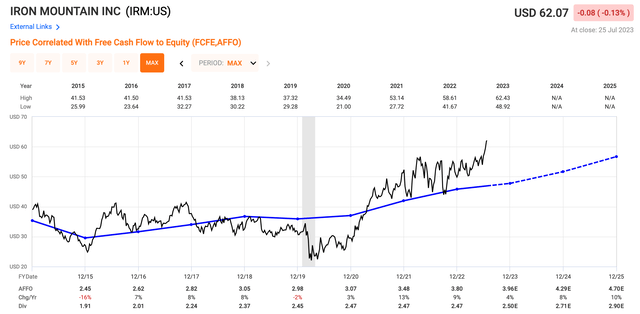
With Q2 2023 earnings coming out next week, there are a few numbers to watch. In particular, I’m keen to see if service revenue growth picks up closer to historical levels and also if IRM can continue to grow their organic storage revenue by double-digits. If so, it would indicate that demand remains strong and the stock price outperformance may continue. If not, a slowdown in growth could be the negative catalyst that sends the price lower.
Credit: Source link