

















Last month, theoretical physicist Avi Loeb made headlines with the sensational claim that tiny spherules recovered from the bottom of the ocean were probably of alien origin. “It’s most likely a technological gadget with artificial intelligence,” he said to The New York Times, which published a story today about the Harvard professor’s contentious claims. Although the biggest scientific breakthroughs often start with a bold hypothesis, Loeb’s peers believe the decorated astrophysicist’s assertions can be called many things — but “good science” isn’t one of them.
Loeb’s proclamations stem from an object that US government sensors logged on January 8th, 2014: a fireball from space that blazed into the western Pacific Ocean off the northeastern coast of Papua New Guinea. Highlighting its logged speed and direction as an anomaly, Loeb and undergraduate assistant Amir Siraj targeted the otherwise inconsequential planetary entry as an object worthy of further investigation.
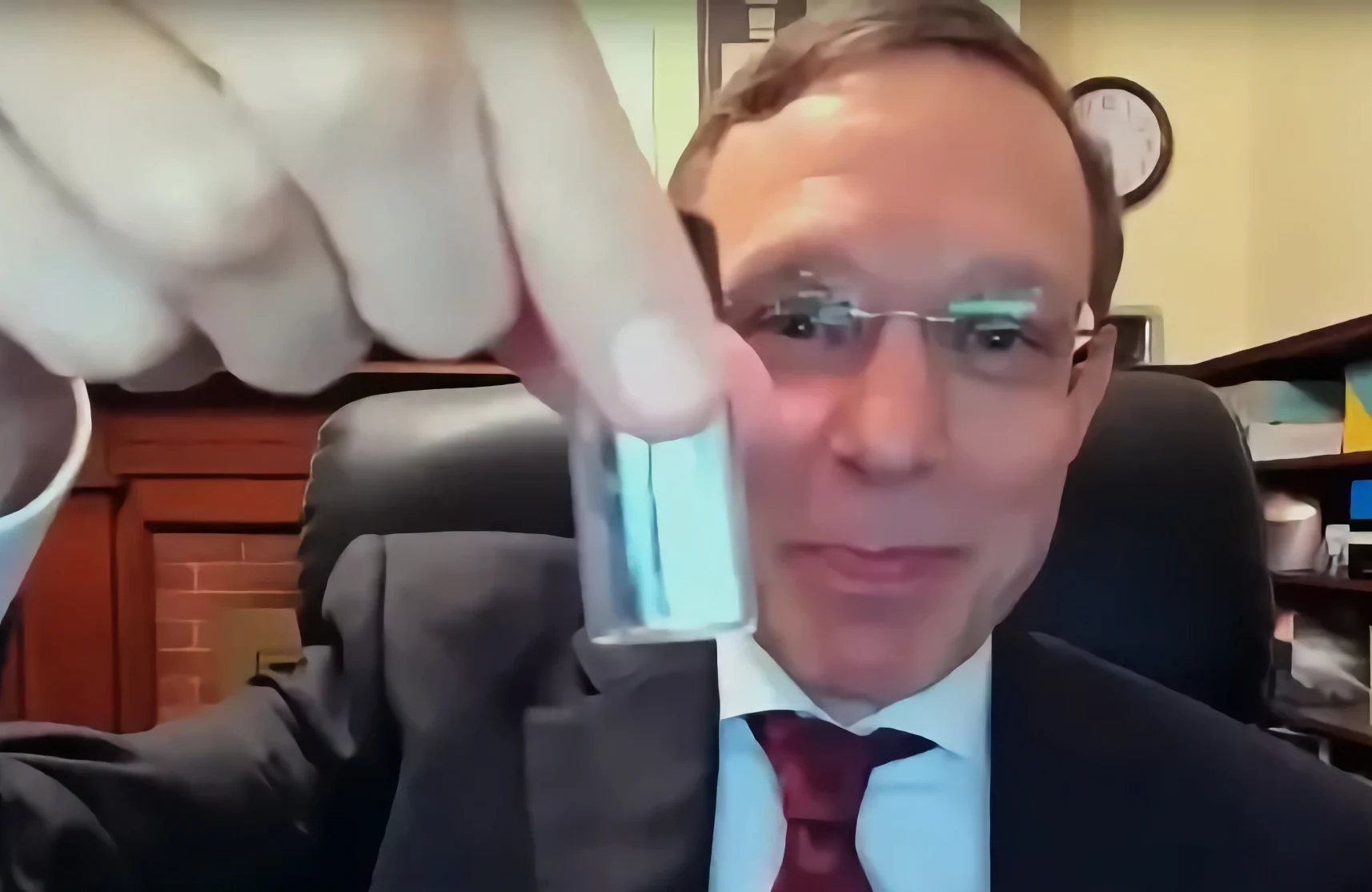
Fast-forward to last month, when Loeb led a voyage — funded by a crypto entrepreneur — to recover evidence from the fireball’s calculated crash path. Dragging a magnetic sled attached to the expedition boat across the ocean floor, the team recovered a series of tiny spherical objects which Loeb says “appear under a microscope as beautiful metallic marbles.” Preliminary analysis indicated that the sub-millimeter orbs were 84 percent iron, with silicon, magnesium and trace elements comprising the rest. Loeb believes that “as a result of being exposed to the fireball’s heat, the surface of the object likely disintegrated into tiny spherules, similar in number per unit area to those recovered by the expedition.”
Avi Loeb / Medium
Not one to exercise much caution with public pronouncements, Loeb wrote in a Medium post, “Their discovery opens a new frontier in astronomy, where what lay outside the solar system is studied through a microscope rather than a telescope.” He summarized, in an equally dramatic manner, “The discovery of spherules felt like a miracle.” Soon after, CBS News picked up on his excitement and published an attention-grabbing article titled, “Harvard professor Avi Loeb believes he’s found fragments of alien technology.” Loeb has sent the mysterious spheres to Harvard University, the University of California, Berkeley and the Bruker Corporation in Germany for more in-depth analysis.
“It has material strength that is tougher than all space rock that were seen before, and catalogued by NASA,” CBS News reported Loeb as saying earlier this month. “We calculated its speed outside the solar system. It was 60 km per second, faster than 95% of all stars in the vicinity of the sun. The fact that it was made of materials tougher than even iron meteorites, and moving faster than 95% of all stars in the vicinity of the sun, suggested potentially it could be a spacecraft from another civilization or some technological gadget.”
It all sounds fascinating, especially with the resurgent interest in UFOs and the quest to discover signs of alien life. But there’s one problem: The scientific community, by and large, believes Loeb is, if not entirely full of it, practicing something far outside what they’d call science.
Peter Brown, a meteor physicist at Western University in Ontario, said that “several percent” of detected events appear interstellar at first but almost always end up chalked up to a measurement error. Steve Desch, an astrophysicist at Arizona State University, argued at a recent conference that if the object were traveling as fast as the data suggests — one of the points Loeb uses to indicate its origin was from outside our solar system — it would have been wholly incinerated entering the Earth’s atmosphere. Brown and other scientists also highlight Loeb’s lack of engagement with peers who study similar unidentified fireballs.
Brown recently presented data (accepted for publication in The Astrophysical Journal) demonstrating that NASA’s recordings in cases like these often end up being proven untrustworthy. He believes the fireball likely impacted at a slower speed than the recorded data suggested. “If the speed was overestimated, then the object becomes, more or less, within the realm of what we see in terms of other bound solar system objects,” he said. (Loeb retorted by citing an unbendable trust in government data: “They are responsible for national security. I think they know what they are doing.”) The New York Times adds that the government is unlikely to declassify the data that would allow the scientific community to learn how precise (or not) it is.
Avi Loeb / Medium
Regardless of the spherules’ origins, researchers are alarmed by Loeb’s penchant for venturing outside science to make bold (and highly publicized) claims — with his scientific background boosting their perceived legitimacy. The gist of their alarm is that becoming a Harvard-employed astrophysicist doesn’t grant you the wizard-like ability to know the answers to questions the scientific method hasn’t yet confirmed. On the contrary, it’s supposed to mean your peers respect you for exercising restraint and doing quite the opposite. “[Loeb’s claims are] a real breakdown of the peer review process and the scientific method,” Desch said to The New York Times. “And it’s so demoralizing and tiring.”
Loeb’s views about his peers’ harsh response can be summarized in his cited quote from philosopher Arthur Schopenhauer from a recent blog post. “All truth passes through three stages: First, it is ridiculed; second, it is violently opposed; and third, it is accepted as self-evident.” Notably, Loeb seemingly refers to his conclusions about the preliminary findings — with plenty of question marks still intact — as “truth.”
The Oxford English Dictionary defines confirmation bias as “the tendency to interpret new evidence as confirmation of one’s existing beliefs or theories.” Loeb’s words and excited tone suggest he knows the answer and that his peers’ criticism stems from their resistance to the new frontier he’s discovered. However, their criticism seems only partially about his specific conclusions; it’s paired with a larger concern about an esteemed cohort jumping to conclusions that fall far outside of the scientific method. “What the public is seeing in Loeb is not how science works,” remarked Desch. “And they shouldn’t go away thinking that.”
Credit: Source link