

da-kuk
Higher Federal Reserve rates have led to higher yields on most asset classes, and to significant dividend growth for most fixed-income exchange-traded funds, or ETFs. Local currency emerging market debt is more or less the only exception, with almost no change in yield these past few years. As yields have stagnated, said asset class does not currently offer competitive, attractive dividends to investors. The VanEck J.P. Morgan EM Local Currency Bond ETF (NYSEARCA:EMLC) invests in these securities and has seen stagnating dividends these past few years, and so is not a compelling investment opportunity right now.
EMLC – Quick Overview
EMLC is an index ETF investing local currency emerging market debt, issued by sovereign and quasi-sovereign entities, subject to a basic set of inclusion and exclusion criteria. The fund holds a diversified portfolio of bonds, with investments in dozens of countries and issuers.
EMLC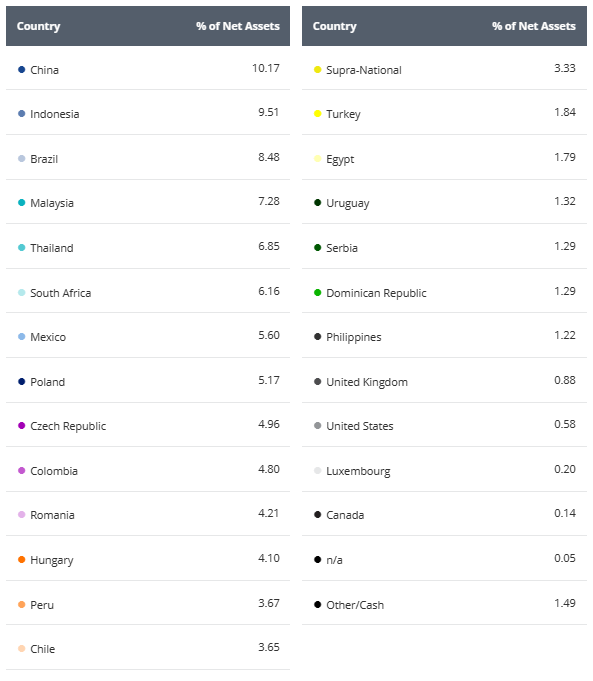
EMLC focuses on comparatively safe emerging markets, with investment-grade securities comprising almost 80% of the value of the fund.
EMLC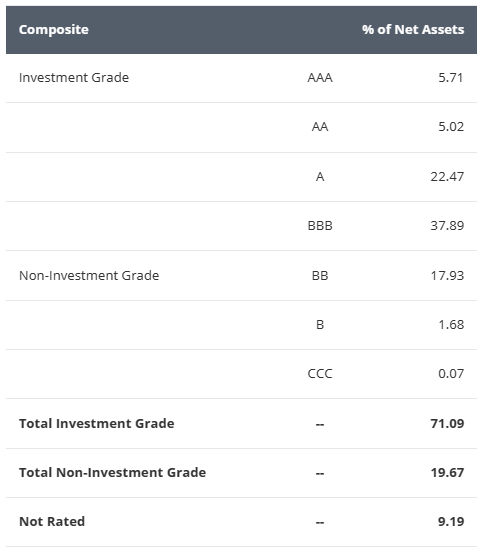
Although emerging markets are, as a whole, quite risky, investment-grade sovereign issuers do have low credit risk. On the other hand, foreign currency risk is quite high, as emerging market currencies are incredibly volatile. Expect losses and underperformance when the dollar strengthens, as was the case from early 2021 to late 2022, as higher rates led to higher demand for dollar assets.
Data by YCharts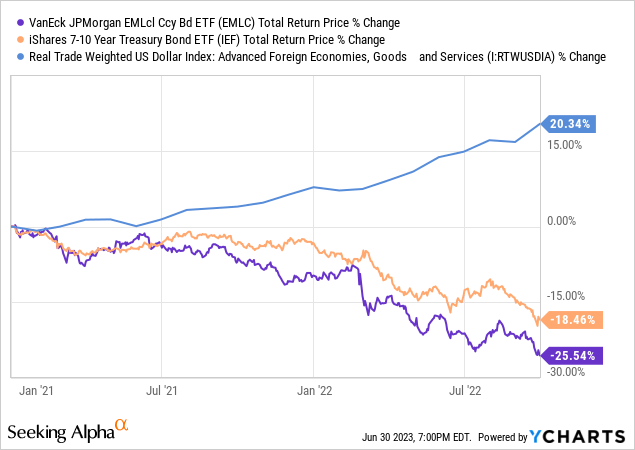
On the flip side, expect higher gains and outperformance when the dollar goes down, as has been the case since late 2022.
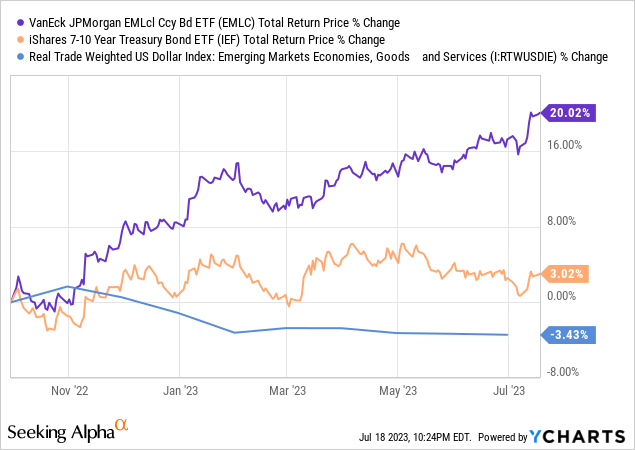
EMLC’s foreign currency risk is a negative for the fund and its shareholders, and an important disadvantage vis a vis most other bond funds. Said risk is particularly relevant right now, as safe, stable investments like T-bills and CDs offer competitive yields without currency risk.
EMLC’s interest rate risk is somewhat lower than average, with an average time to maturity of 7.1 years, duration of 5.0.
EMLC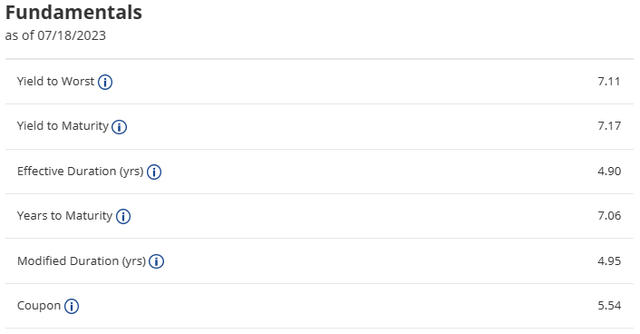
For reference, the benchmark iShares Core U.S. Aggregate Bond ETF (AGG) has an average time to maturity of 8.7 years, duration of 6.3.
AGG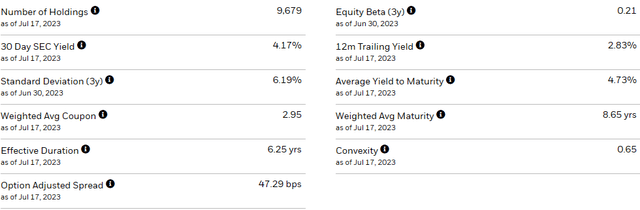
EMLC’s lower interest rate risk means lower losses when interest rates rise, with two important caveats.
First, EMLC tends to see losses when the dollar strengthens, which tends to happen when the Fed hikes rates (due to greater demand for dollar-denominated financial assets with higher yields). These losses could outweigh the fund’s lower interest rate risk.
Second, EMLC invests in a relatively niche asset class, whose prices and yields might not necessarily move in-line with those of most bonds. Which brings me to my next point.
EMLC – Dividend Analysis
EMLC currently offers investors a 5.1% dividend yield. It is a reasonably good yield, higher than that of most bonds and bond sub-asset classes, although lower than that of high-yield corporate bonds and senior loans.
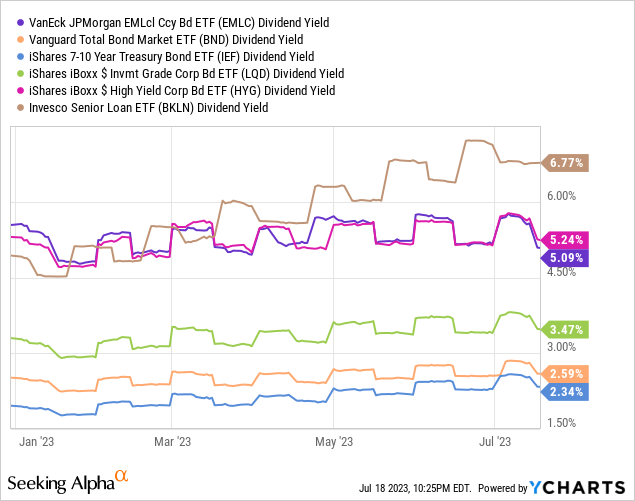
On a much more negative note, EMLC’s dividends have stagnated these past few years, even as most bond funds see significant dividend growth due to Federal Reserve hikes.
Data by YCharts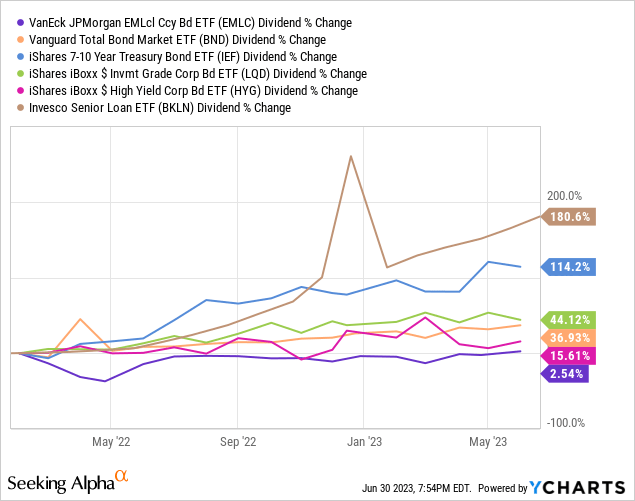
To explain the above, some context first.
When the Federal Reserve hikes or cuts rates, they target a specific interest rate called the Federal Funds Rate. Said rate is technically equal to the overnight interbank lending rate but, for our purposes, we can say it is equal to the short-term, risk-free rate on dollar-denominated assets.
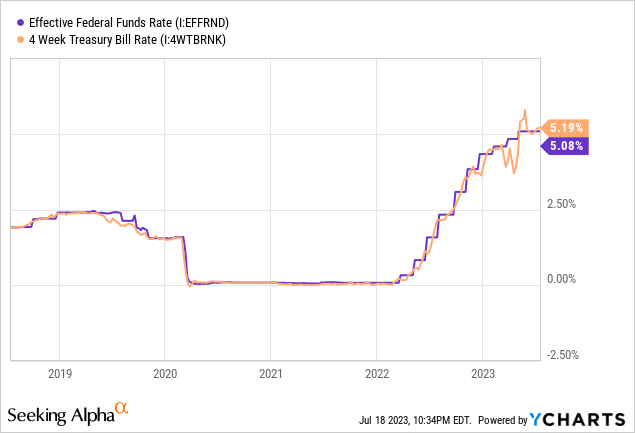
T-bills are short-term, (effectively) risk-free, dollar-denominated assets, so their yields are always quite close to Fed rate (in the table below, volatility is due to data issues).
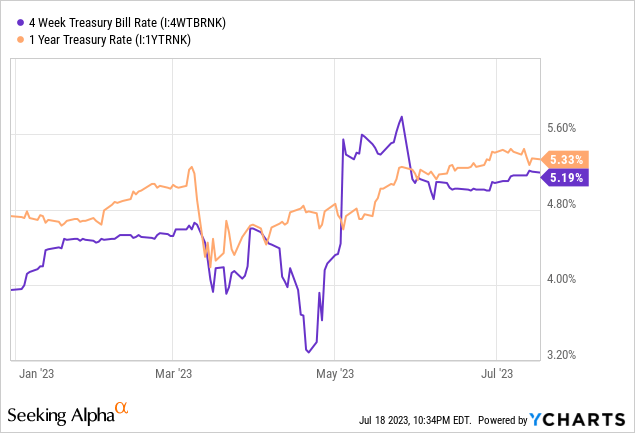
Other asset yields are strongly dependent on Fed rates, but are influenced by other factors too, including expectations of future rates. 1 year treasuries, for instance, currently yield 0.15% more than T-bills, as investors expect one more 0.25% hike in the coming months, followed by a cut later next year.
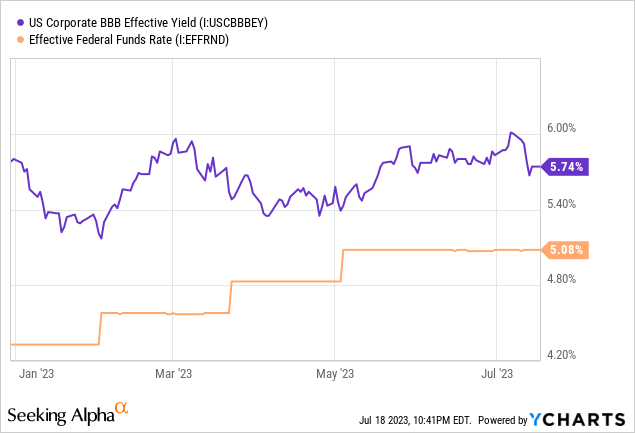
High-yield corporate bond yields are much higher than Fed rates, as investors demand much higher yields due to credit risk. Still, yields for this asset class are quite clearly influenced by Fed rates, as can be seen below.
Emerging market sovereign debt issued in local currency, on the other hand, is not so closely linked to Fed rates, as these are very different securities / investment markets. Investors in, say, Chinese government debt will not simply dump their position because T-bills yield more, as these securities have much more foreign currency risk (for foreign investors), and as there are capital controls in the country limiting investors from doing so.
At the same time, foreign countries have their own central banks, and these might not move in-line with the Fed. The People’s Bank of China recently cut rates, for instance. Chinese asset yields are obviously much more dependent on local central bank rates than on Fed rates, so Chinese asset yields might not necessarily move in-line with Fed rates.
Finally, and on a more practical note, higher Fed rates might end up impacting foreign exchange rates more than interest rates, as higher demand for dollar-denominated assets boost the price of the dollar. This is particularly likely if foreign central banks keep rates steady / hike by less than the Fed. This is exactly what happened in 2022, as the aggressive pace of Fed hikes meant spreads between dollar-denominated assets and those issued in other currencies were wide, leading to higher dollar prices. Graph as per JPMorgan, I’ve bolded the relevant time frames.
JPMorgan Guide to the Markets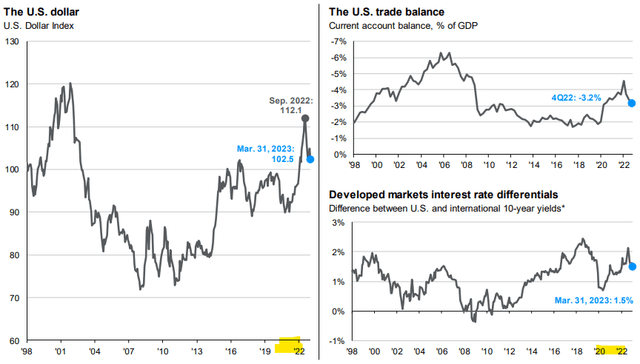
So, higher Fed rates might not necessarily lead to higher interest rates on foreign investment securities, as has been the case for emerging market debt these past few years. As per JPMorgan Chase (JPM), this is the only fixed-income sub-asset class not yielding much more now than in the past.
JPMorgan Guide to the Markets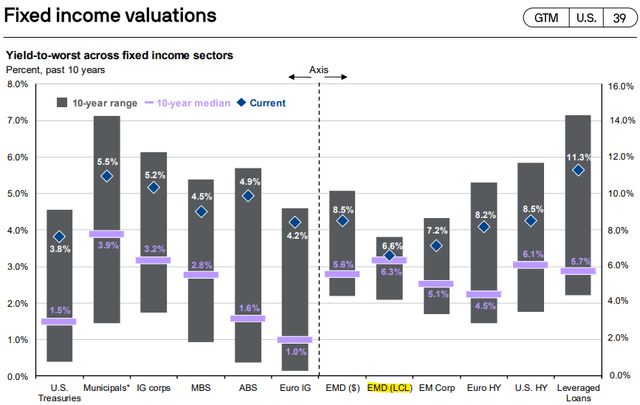
Foreign investors might prefer, or be forced into, these securities. U.S. investors, or those located in other developed countries, have few reasons to invest in the same.
EMLC – Price and Potential Capital Gains Analysis
As mentioned previously, higher Fed rates sometimes lead to higher dollar prices, as was the case during most of 2022.
Data by YCharts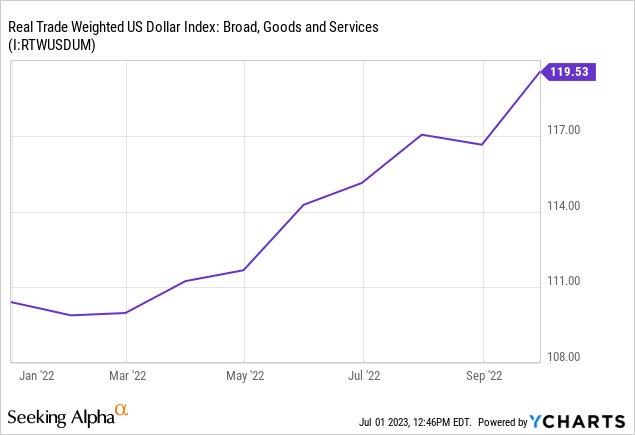
Corollary of the above is that international investments could see higher prices and strong capital gains moving forward, contingent on the dollar coming back down. The issue is, the dollar has already come down, and prices are only around 2% higher than their historical averages.
JPMorgan Guide to the Markets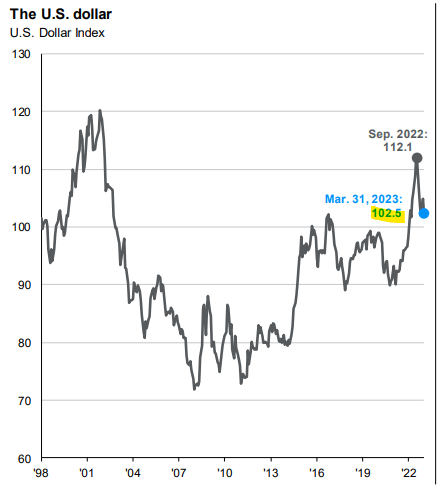
Some further capital gains are still a bit likely, as the dollar is a bit more expensive than average, and as emerging market currencies have seen weaker performance these past few years. Significant gains do not seem terribly likely, in my opinion at least.
Although the lack of gains is not a negative per se, it does mean that the fund’s overall prospective returns and investment thesis are quite weak. Comparatively, weak dividends might not have mattered when potential capital gains were strong, but they do matter right now.
Conclusion
VanEck J.P. Morgan EM Local Currency Bond ETF offers investors comparatively weak dividends and low potential capital gains right now. Under these conditions, I see no reason to invest in the fund.
Credit: Source link