
David Ramos
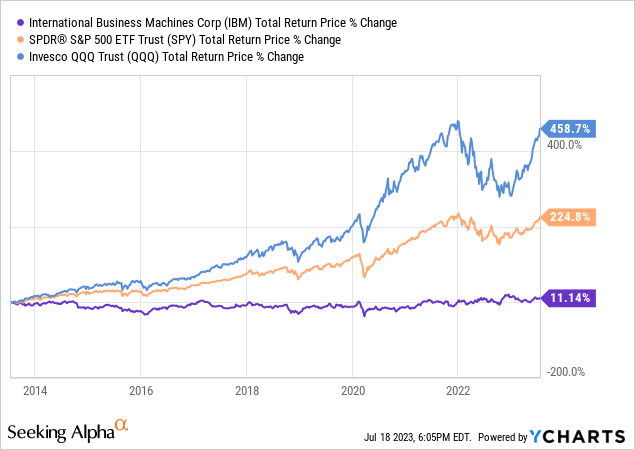
International Business Machines Corporation stock (NYSE:IBM) has floundered for an extended period of time, due to lackluster topline growth due to the lack of blockbuster product innovation, a growing debt pile, and ill-timed buybacks. As a result, IBM stock has delivered significant underperformance of the S&P 500 (SPY) and especially the tech-heavy NASDAQ (QQQ) over the past decade:
That said, the forward dividend yield of ~5% alongside the impressive 28-year dividend growth streak (making it a prestigious Dividend Aristocrat (NOBL)), the defensive moat around its existing earnings stream provided by its vast intellectual library profile, and latest innovations in the red-hot field of artificial intelligence make it an intriguing option ahead of its Q2 earnings release.
Despite these positives, we believe the risk-reward remains unappealing and remains on the sidelines of IBM stock ahead of Q2 earnings. Here are three reasons why:
Reason #1: IBM’s A.I. Growth Potential Remains Speculative
IBM’s artificial intelligence dreams are being staked on its recently unveiled A.I. and data platform: Watsonx. It consists of three product sets: IBM watsonx.ai, IBM watsonx.data, and IBM watsonx.governance, though no pricing details were released during its May launch. IBM’s CEO introduced the product by stating:
Foundation models make deploying AI significantly more scalable, affordable, and efficient. We built IBM watsonx for the needs of enterprises, so that clients can be more than just users, they can become AI advantaged. With IBM watsonx, clients can quickly train and deploy custom AI capabilities across their entire business, all while retaining full control of their data.
While IBM certainly has a vaunted intellectual property portfolio and has invested considerably in data analytics and computational technology over the years, it is uncertain how innovative and differentiated these products truly are compared to the competition.
It certainly is reasonable to expect that IBM may have success selling these Watsonx products to existing customers due to convenience and switching cost factors, but it is much less certain how well they will actually be able to grab additional market share with it. In other arenas of recent technological innovation – such as in cloud computing – IBM has failed to win to any significant degree against other tech giants such as Oracle (ORCL), Alphabet (GOOG) (GOOGL), and Amazon (AMZN), so it would be a pretty speculative bet to expect IBM to grab meaningful market share from A.I. rivals as well.
On top of that, IBM reported a pretty paltry 1% (3% constant currency) topline growth rate in Q1 for its Data & A.I. segment, so there will need to be substantial innovation from Watsonx and IBM will have to market it extremely effectively in the face of stiff competition to drive any sort of meaningful growth for the segment.
Given that IBM stock has already seen a pretty strong tailwind from its Watsonx launch, it is hard to expect too much more of a tailwind from it until it begins to drive any meaningful growth beyond incremental revenue from existing customers.
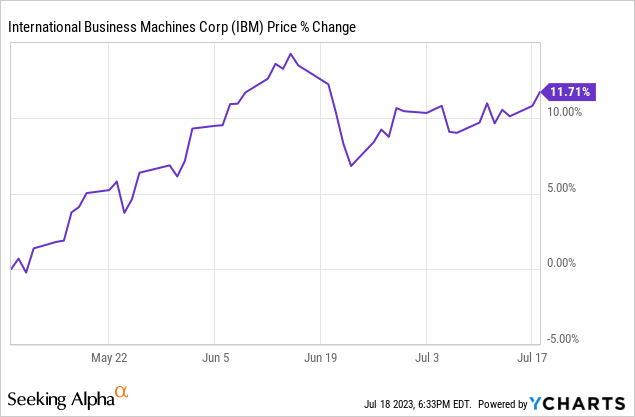
If anything, the 11.71% stock price increase is likely already pricing in expectations of meaningful growth beyond incremental organic growth, so the risk-reward from this potential catalyst is not very appealing at the moment.
Reason #2: IBM’s Red Hat Growth Has Been Underperforming Expectations
IBM’s previous major growth catalyst was supposed to come from its Red Hat acquisition, which it paid a whopping $34 billion four years ago.
However, in Q1, warning signs began flashing for Red Hat’s growth story. Management had originally expected Red Hat revenue to grow at a mid-single digit pace this year, helping to drive top line growth. Unfortunately, it grew at only half that pace (7-8% when adjusting for deferred revenue) in Q1, prompting management to cut its full-year 2023 guidance to 11-13%.
Obviously, if they fail to generate significant growth acceleration in Q2, this guidance will likely need to be revisited again. If that ends up happening, the core of IBM’s revenue growth story will have taken a significant hit. Once again, we think the risk-reward for significant revenue acceleration in Q2 and beyond is neutral at best for longs. As a result, we think it is best to wait and see how Red Hat performed in Q2 before committing to the stock.
Reason #3: IBM Stock’s Valuation Is Not Appealing
Last, but not least, in addition to speculative at best growth prospects from its two biggest growth engines, IBM’s valuation is not compelling right now.
Its EV/EBITDA stands at 10.73x, well above its five year average of 9.31x. The same can be said of its P/E and P/FCF ratios, with the current P/E ratio sitting at 14.15x relative to its five year average of 11.75x and the current P/FCF ratio sitting at 11.59x compared to its five year average of 10.17x.
These premium valuations are even more notable when considering that interest rates have risen considerably over the past half decade:
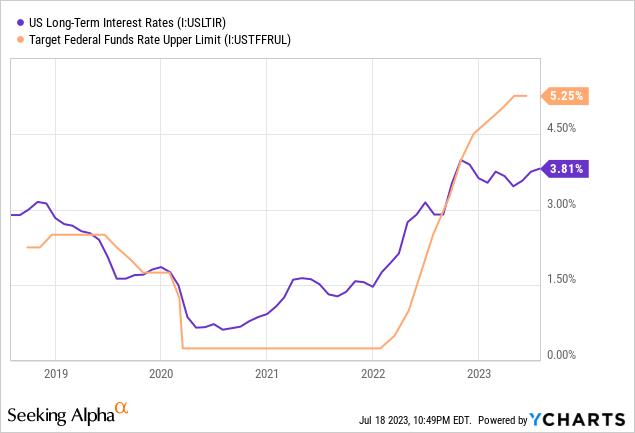
While the near 5% forward dividend yield provides a solid basis for total returns, the premium valuation multiples currently being assigned to the stock require a much more robust growth rate than we think is likely. This is because:
- Their two big growth stories – Red Hat and Watsonx – are facing significant questions as to how much they can truly power growth.
- The company’s heavy debt burden is forcing management to prioritize the balance sheet, preventing it from buying back stock (even as its share count grows due to substantial stock-based compensation) and limiting its ability to continue growing the dividend at more than a token low single digit CAGR.
- IBM will continue to face stiff competition from deep-pocketed big tech firms that have deep talent pools as well. This will continue to hamper their ability to grow outside of their current client base.
Investor Takeaway
IBM offers investors an intriguing combination of high current yield and A.I. exposure. For those reasons alone it may be worth it for dividend focused investors to buy the stock. However, in our view, at the current valuation, it makes sense to stay on the sidelines until IBM’s growth story becomes more proven or the valuation becomes more attractive.
Credit: Source link